ACLM

ADMM-Based Distributed MPC for Collaborative Loco-Manipulation

ACLM: ADMM-Based Distributed MPC for Collaborative Loco-Manipulation

Scenario overview

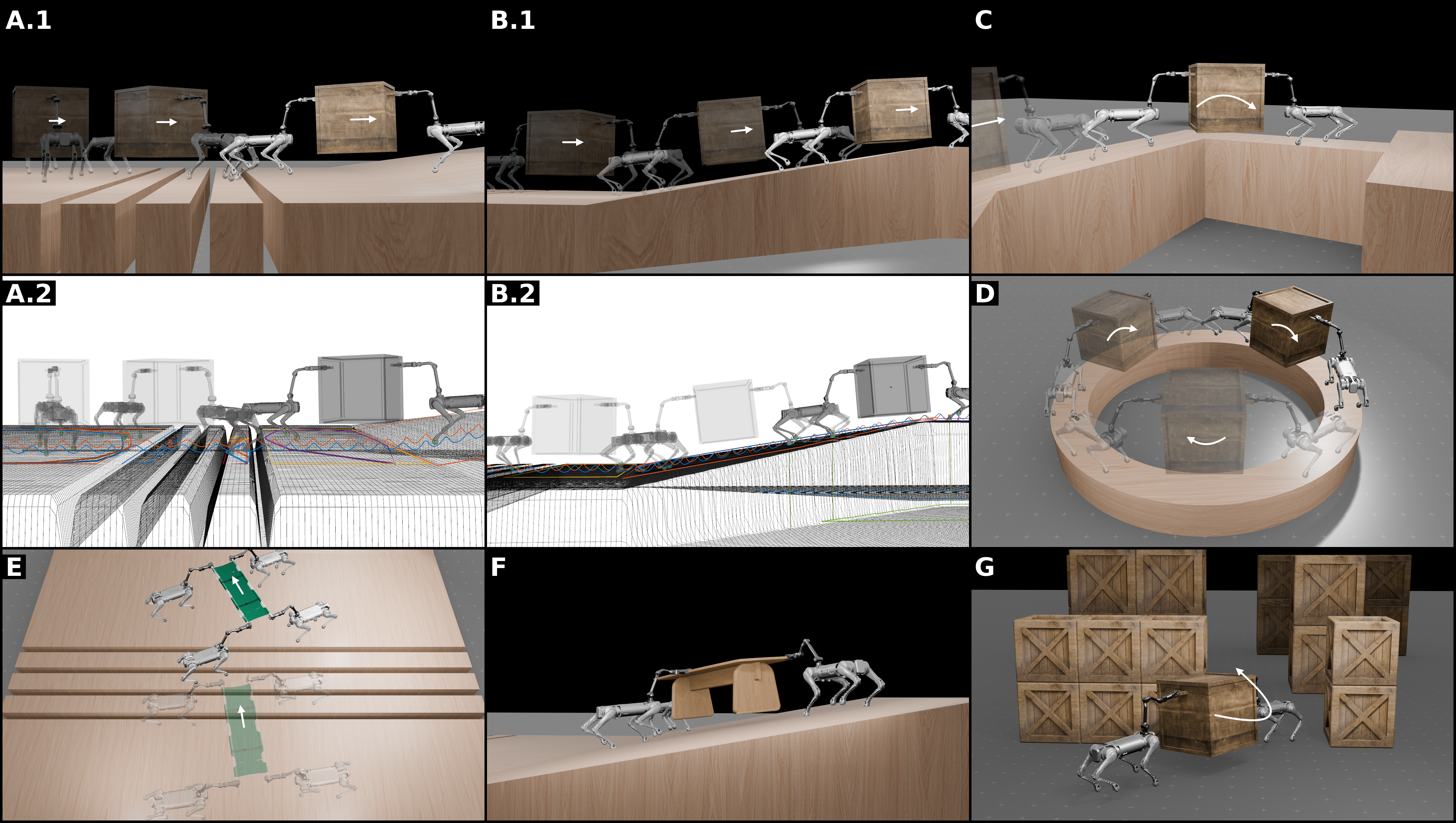
Rough-terrain scenarios with a shared cargo box: Gap (A), Slope (B), Narrow Turn (C), and Annular platform (D); multi-robot scalability with three-robot Gap and four-robot Slope using different payloads (E–F); and the obstacle-avoidance setup (G).

Video

Abstract

Collaborative transportation of heavy payloads via loco-manipulation is a challenging yet essential capability for legged robots operating in complex, unstructured environments. Centralized planning methods, e.g., holistic trajectory optimization, capture dynamic coupling among robots and payloads but scale poorly with system size, limiting real-time applicability. In contrast, hierarchical and fully decentralized approaches often neglect force and dynamic interactions, leading to conservative behavior. This study proposes an Alternating Direction Method of Multipliers (ADMM)-based distributed model predictive control framework for collaborative loco-manipulation with a team of quadruped robots with manipulators. By exploiting the payload-induced coupling structure, the global optimal control problem is decomposed into parallel individual-robot-level subproblems with consensus constraints. The distributed planner operates in a receding-horizon fashion and achieves fast convergence, requiring only a few ADMM iterations per planning cycle. A wrench-aware whole-body controller executes the planned trajectories, tracking both motion and interaction wrenches. Extensive simulations with up to four robots demonstrate scalability, real-time performance, and robustness to model uncertainty.
Approach Summary

ADMM distributed MPC framework

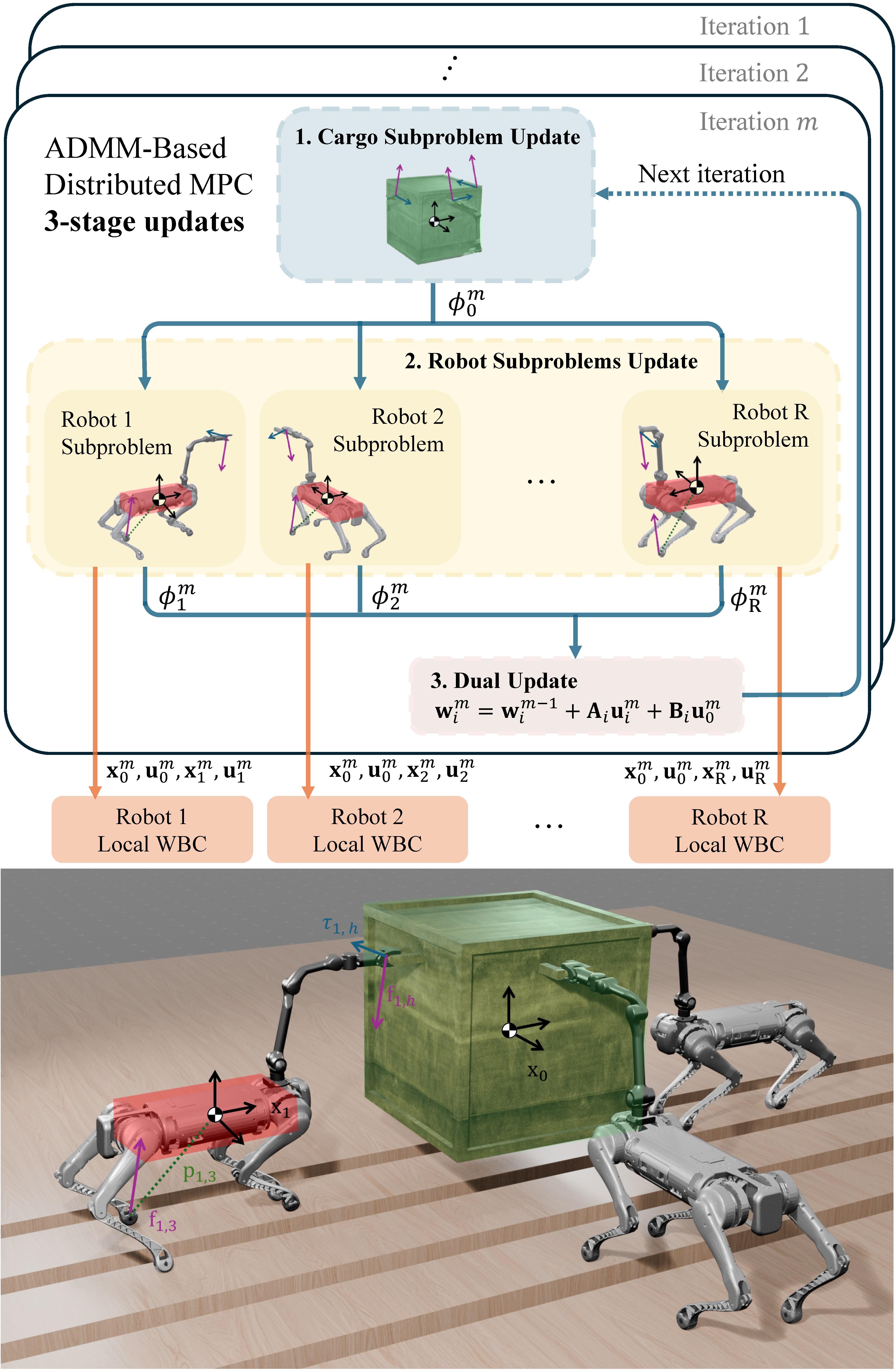
System overview: robot subproblems are solved in parallel with consensus on interaction wrenches; trajectories are executed by local wrench-aware WBC.

We decompose the tightly coupled multi-robot optimal control problem by exploiting the star-shaped coupling induced by the shared payload: each robot interacts directly with the payload rather than with other robots. This allows consensus ADMM to split the problem into a payload subproblem and parallel robot-level subproblems, with consensus constraints only on the manipulation wrenches (force and torque). The payload dynamics use local copies of these wrenches; each robot subproblem uses the payload state from the previous ADMM iteration, keeping subproblems tractable. With warm-starting across MPC windows, only a few ADMM iterations per cycle are needed. A hierarchical wrench-aware whole-body controller then tracks the optimized poses and interaction wrenches at 500 Hz, ensuring force-consistent execution.

Rough Terrain

Gap — Stepped terrain, adaptive swing heights

Slope — 10° incline, base and cargo compensating for tilt

Narrow Turn — 90° turn in narrow passage

Annular — Circular path on elevated platform

Obstacle Avoidance

Collision-free navigation with CBF constraints; MPC finds feasible trajectories through narrow passages.

Two robots with cargo avoiding box obstacles (Gazebo + Blender)

Scalability & Analysis

We highlight three contributions:

  • Real-time distributed planning that scales with team size
  • Tight integration of MPC with wrench-aware whole-body control
  • Robustness under model uncertainty and full wrench tracking

Scalability — Real-time performance independent of team size

Our ADMM decomposition preserves dynamic coupling (consensus on interaction wrenches) while yielding parallel robot-level subproblems. Centralized MPC solves one large OCP that grows with robot count; we validate on flat and Gap–Slope terrain with 2–4 robots and diverse payloads.

Three robots — Gap, cargo box

Four robots — Slope, cargo box

Three robots — Slope, table payload

Four robots — Gap, folding stretcher

Scalability analysis

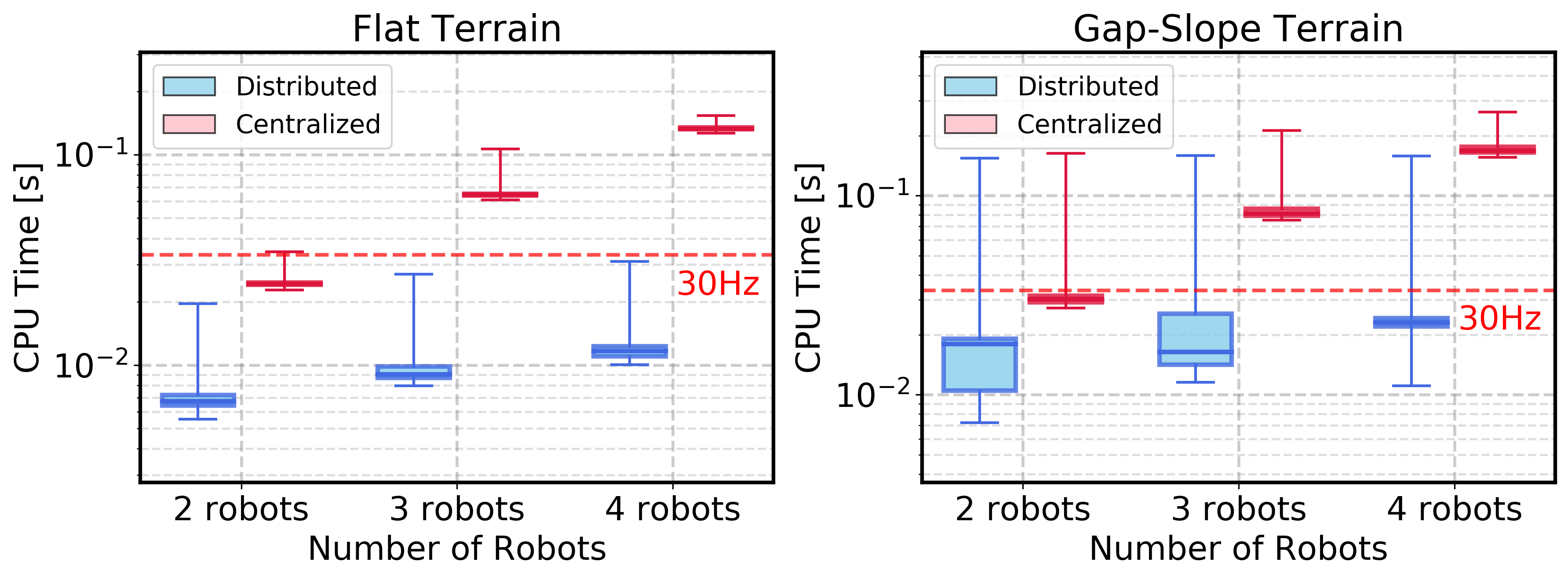
CPU time: distributed vs centralized MPC for 2–4 robots (flat and Gap–Slope). Red dashed line: 30 Hz real-time threshold.

Distributed MPC achieves 3.6×–11.4× speedups on flat terrain (median 6.73–11.63 ms vs 24.38–133.13 ms centralized) and 1.7×–7.3× on Gap–Slope, staying at 50 Hz (100 Hz flat) for all team sizes; centralized drops below 30 Hz for 3–4 robots. The decomposition thus delivers real-time performance without sacrificing coupling-aware planning.

Fast convergence with few ADMM iterations

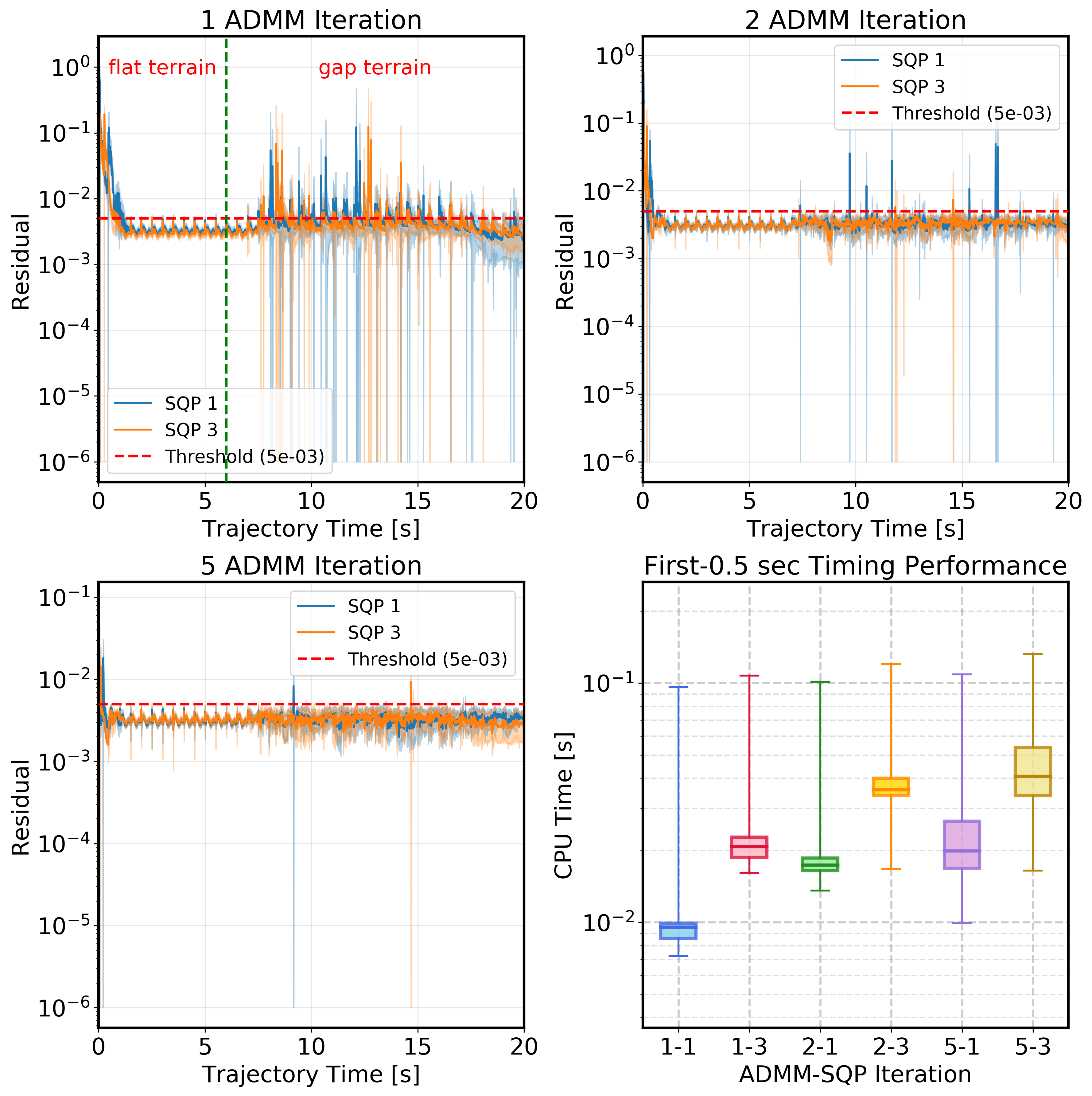
We use 2 ADMM and 1 SQP iteration per MPC solve. Warm-starting from the previous window lets consensus on wrenches converge quickly; we validate with 60 trials on Gap terrain across waypoints and configurations.

MPC residuals and computation time

Residual convergence and computation time across ADMM–SQP configurations.

One ADMM iteration leaves residuals unsuppressed in the gap phase; two keep them in tolerance with rare violations; five improve further at higher cost. More SQP iterations also increase solve time. The 2+1 choice balances constraint satisfaction and real-time efficiency—the pipeline does not need many iterations to stay stable.

Obstacle avoidance with integrated MPC–WBC

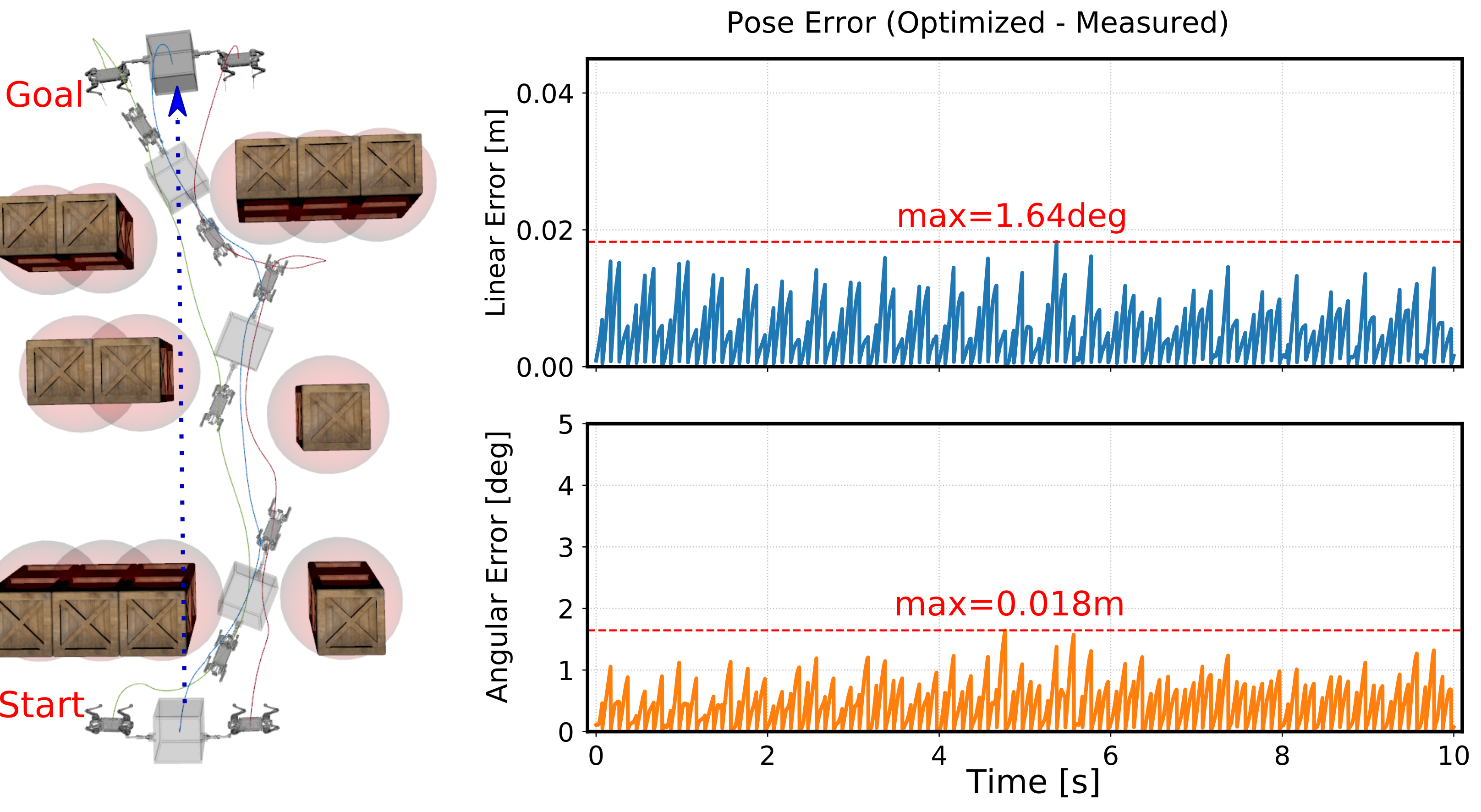
We add obstacle avoidance via CBFs in the distributed MPC and run the wrench-aware WBC in Gazebo (Blender rendering). The question is whether collision-free plans are accurately tracked while enforcing wrench consistency at the grasps.

Obstacle avoidance overview

Left: collision-free trajectory through obstacles. Right: pose tracking error over a 10 s segment (full task 110 s).

With only start-to-goal reference, MPC finds feasible paths through narrow passages. Max tracking errors are 0.0183 m and 1.644° over a 10 s window; spikes at ground impact stay bounded. The integrated MPC–WBC thus achieves real-time obstacle avoidance with accurate, force-consistent execution.

Robustness to mass and inertia uncertainty

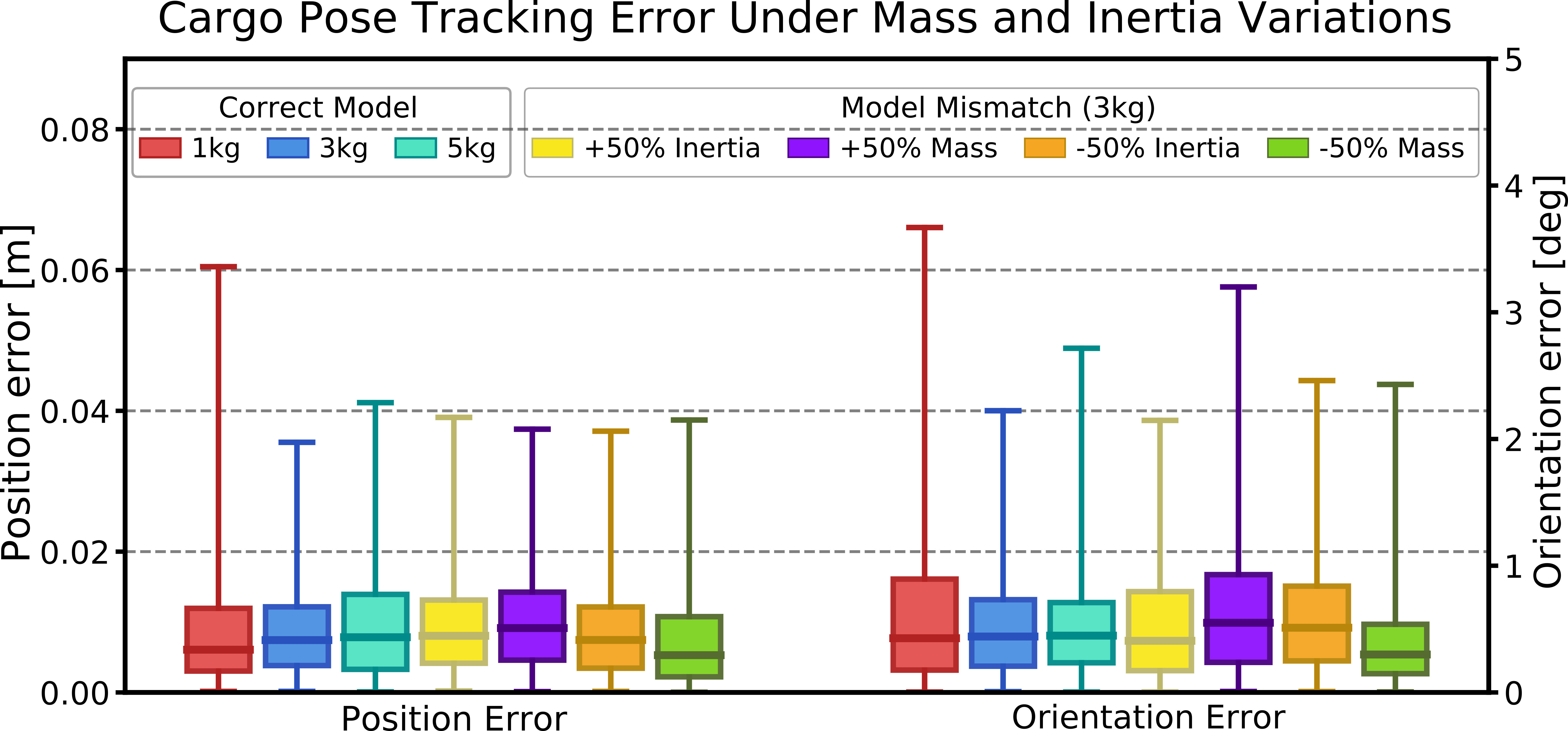
We stress-test with varied nominal cargo mass and deliberate mass/inertia modeling errors (reference: 6.5 m translation + 90° rotation). Explicit wrench optimization and tracking let the WBC compensate in a force-consistent way.

Robustness under mass and inertia variation

Cargo pose tracking errors under different nominal masses and parameter perturbations.

Median errors stay low across masses and errors; failure appears only near ~67% modeling error. Overestimated mass/inertia improves robustness (larger wrenches, more margin). This underscores the value of explicit wrench computation and tracking versus position-only tracking.

Why full wrench tracking matters — ablation

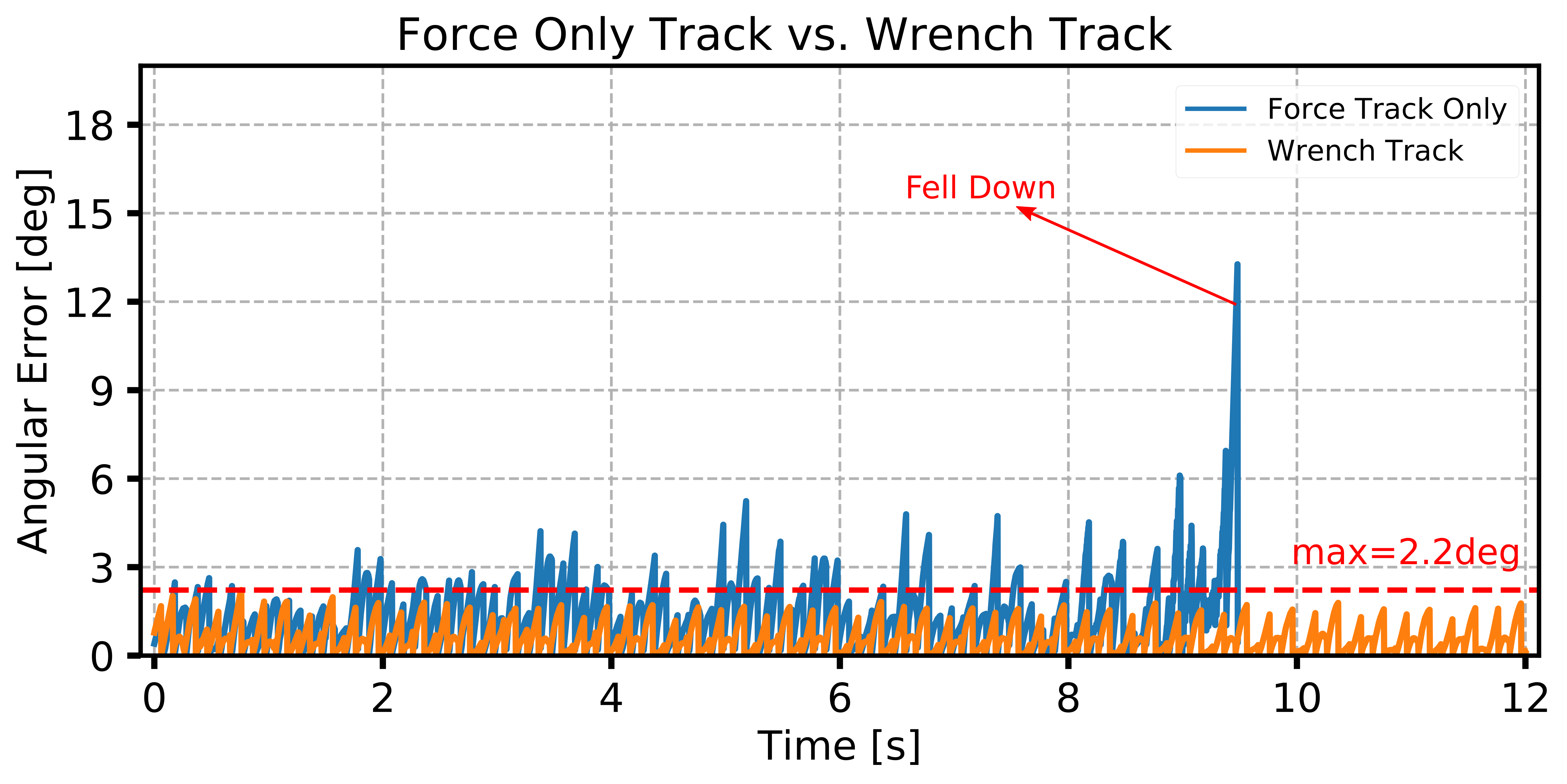
We optimize and track the full 6-DoF wrench at the grasps. Ablating torque (force-only tracking) tests whether this is necessary.

Force-only tracking — angular error grows, instability

Full wrench tracking — stable, accurate transport

Force-only vs full wrench tracking

Force-only vs full wrench tracking: angular error and stability.

Force-only tracking leads to growing angular error and instability. Enabling torque—especially about the robot–cargo alignment axis—restores stability; vertical torque stays tightly constrained to avoid slip. The wrench-aware WBC is thus essential for stable, accurate collaborative transport, not an optional add-on.